
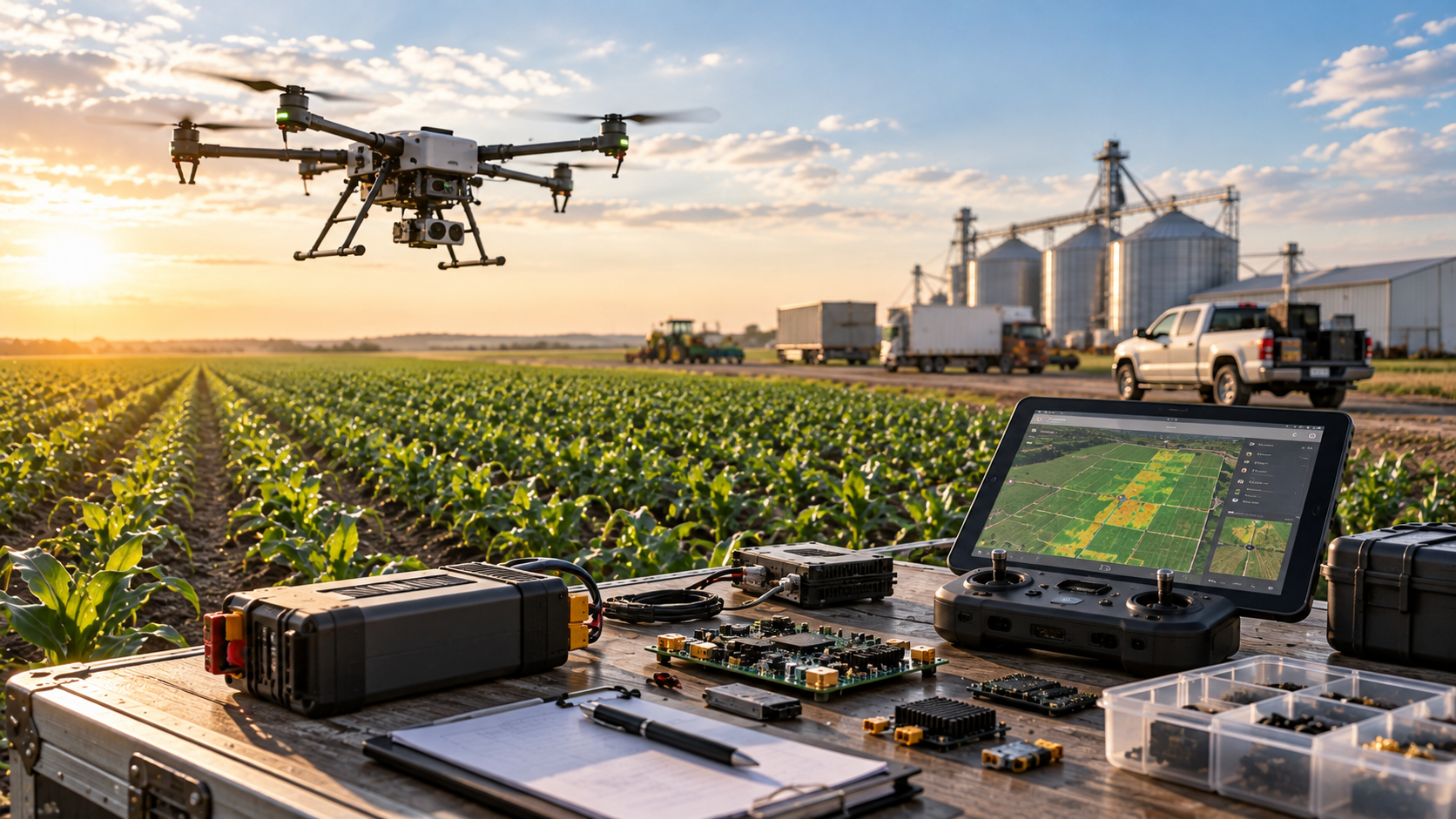
Agricultural drones are changing how modern farms monitor crops, collect field data and manage agricultural operations. What once required extensive manual inspections or specialized machinery can now, in many cases, be supported by unmanned aerial systems equipped with advanced electronics and intelligent software.
Behind every agricultural drone is a complex system of electronic components. Flight controllers, GNSS/RTK positioning modules, sensors, communication systems, batteries and motor controllers work together to ensure accurate navigation, stable operation and reliable data collection. The performance of the entire system depends on the quality and compatibility of these elements.
One of the most important applications is crop monitoring. Drones equipped with multispectral and thermal cameras help agricultural businesses identify variations in plant health, detect potential water stress and monitor field conditions. This information supports more informed decisions about irrigation, crop protection and resource management.
Another important application is precision spraying and agricultural treatment, where permitted by applicable regulations. Such systems rely on accurate navigation, electronic flow control, sensors and automated flight management. Their effectiveness depends not only on the mechanical structure of the drone, but also on the reliability of its electronics and control systems.
For equipment manufacturers and agricultural service providers, this creates a growing need for specialized components. Batteries, electronic speed controllers, communication modules, connectors, sensors and replacement circuit boards must meet technical specifications and remain available throughout the equipment’s operating life.
However, sourcing these components internationally introduces additional challenges. Suppliers may offer different technical versions, production batches or compatibility standards. Incorrect specifications, inconsistent quality or delayed replacement parts can affect equipment availability and interrupt agricultural operations during critical seasonal periods.
Logistics is another essential part of the equation. Electronic components require appropriate packaging, protection against moisture and electrostatic discharge, accurate documentation and careful handling. Lithium batteries may also be subject to specific dangerous-goods transport requirements. Depending on cargo characteristics and delivery urgency, international supply chains may involve air, sea, road or multimodal transportation.
As agricultural businesses review equipment performance after seasonal field operations and prepare for the next production cycle, early component sourcing becomes particularly important. Planning replacement parts, verifying suppliers and coordinating delivery schedules in advance can reduce the risk of equipment downtime when the next agricultural season begins.
For Kazco Logistics, this is where international component supply meets logistics expertise. Connecting supplier coordination, documentation, cargo storage and multimodal transportation helps businesses organize reliable deliveries of electronic components for modern technologies and industrial applications.
Precision farming depends on more than innovative equipment. It depends on the availability of the components that keep that equipment working. As agricultural technologies continue to develop, reliable international supply chains are becoming an increasingly important part of their successful implementation.